

The Alessandro Torri Collection Library - Torri's Bibliographical Annotations
[Translation of the original Italian text by Renato Nisticò]
Bibliographical annotations are a distinctive feature of the Torri's volumes. Here is an example taken from Dante Alighieri, Divina commedia, a cura di Vincenzo Monti, con note di V. Monti e Giulio Perticari, 3 voll, Milano, Bettoni, 1825 (inv. no. 37 in the 1906 Inventory of the SNS Library).
Torri inserts, before the title page, a printed advertising leaflet by the publisher Bettoni, All’illustre signore Paride Zajotti (in pencil, dated Milan 1828), which, however, as can be inferred from the subsequent note, referred to a previous edition. In ink he writes:
Questa pregevole edizione, oltre ai commenti contenuti nella precedente dello stesso tipografo Bettoni, anno 1824, vol. 2 in 18°, è corredata dalle molte importanti aggiunte che si accennano nella seguente Prefazione. Quella fu dedicata al valente letterato Paride Zajotti, autore di parecchi lodati scritti. A. Torri.
This fine edition, in addition to the commentaries included in the previous one by the same printer, Bettoni, year 1824, 2 vols. in 18mo, is supplemented with the many important additions mentioned in the following Preface. That edition was dedicated to the distinguished man of letters Paride Zajotti, author of several highly praised works. A. Torri
Then at a later time:
Pisa, Gen.o 1845. La dedica allo Zajotti è qui unita. Seppi a Milano che le note compilate furono dal Ch. Franc.o Ambrosoli, ora professore d’eloquenza italiana nell’università di Pavia. Di queste medesime è corredata l’edizione del Dante in 18° dello stesso Bettoni [a margine: Meno quelle del Novati e Perticari]. Morì lo Zajotti nel 1843 a Trieste, ov’era presidente dei Tribunali, ed ora fu pubblicata postuma la sua bella opera Sulla letteratura giovanile. A.T.
Pisa, January 1845. The dedication to Zajotti is enclosed here. I learned in Milan that the notes that were compiled were by Ch. Franc.o Ambrosoli, now Professor of Italian Eloquence at the University of Pavia. These same notes also accompany Bettoni’s 18mo edition of Dante [in the margin: Except for those by Novati and Perticari]. Zajotti died in 1843 in Trieste, where he was President of the Tribunals, and his fine work Sulla letteratura giovanile (On Juvenile Literature) has now been published posthumously. A.T.
There is nothing to add about Perticari and Monti, so well known are they. The contribution Torri makes to historical knowledge can be measured by the information he provides about Zajotti (1783–1843), who, in addition to being a magistrate (a conservative, he was involved, among other matters, in the investigations into Young Italy), was also a “militant” man of letters with classicist ideas. Of Zajotti we recall Del romanzo in generale e dei Promessi Sposi di Alessandro Manzoni discorsi due, 1827, which went through several editions within a few years (our Catalogue of the Barbi Collection includes one from 1846), and Elogio del cavaliere Vincenzo Monti [In Praise of the Knight Vincenzo Monti] (Florence, Tipografia di Gregorio Chiari, 1829). With Manzoni he agreed that, from a theoretical standpoint, the historical novel was unworkable.
Torri’s bibliographical notes are dense with references to minor and lesser-known figures in our literary history. This alone would justify their complete transcription, which I hope will be undertaken in the near future. The structure of the notes is fairly consistent. Beginning with the particularly significant edition he is annotating, Torri records the differences from earlier or later issues, noting innovations, additions, and omissions. Of particular value are his indications regarding the authorship of individual parts or of the publication as a whole—at a time when such information was not always stated on the title page or elsewhere in the volume, and was perhaps never again taken into account by subsequent cataloguers.
Apart from personalizing his books with ownership marks, indexes, and marginalia (a common practice among many scholars of the time), Torri enriched the publications in his possession by inserting heterogeneous typo-editorial materials, drawn from diverse sources. These items, acquired from various sources, were related to but distinct from the "piece" in question. Through this practice, he effectively created original editorial artifacts and unique bibliographic specimens.
As an example example, here is a rather rare copy of the Memorie di Lorenzo da Ponte da Ceneda in tre volumi scritte da esso, published by the author in a second edition in “Nuova Jorca”, Gray & Bunce, printers, in 1829.
On the verso of the leaf preceding the front-page, we find the following annotation by Torri:
Edizione rarissima, essendone venute poche copie in Europa. Questa ha un volume in più della prima. Al presente esemplare sono unite dopo il 2.o tomo (vol. 3.o, p.e 1.a e 2.a) alcune altre poesie e prose regalatemi dall’autore stesso, che le mandò a pochi altri, cioè al suo compatriota ab. Colombo, ed a B.meo Gamba. Vedi l’Indice, al tomo 3.o e la nota che vi scrissi infine. Aless.o Torri
An extremely rare edition, as only a few copies reached Europe. This edition includes one more volume than the first. Bound with the present copy, after the second tome (Vol. 3, parts 1 and 2), are several other poems and prose pieces gifted to me by the author himself, who sent them to only a few others—specifically to his compatriot Ab. [i.e., Abate] Colombo and to B.meo (i.e., Bartolomeo) Gamba. See the Index in Volume 3 and the note I wrote at the end. Aless.o Torri.
Questo l’”Indice” vergato a penna dal Torri:
La seconda parte del volume 3.0 delle Memorie (1830) / 1.o Le nozze di Figaro, il Don Giovanni, e L’Assur re d’Ormus, drammi 1826 / 2.o Alcune poesie (anteriori al 1800) / 3.o Catalogo ragionato di libri. 1823 / 4.o Storia incredibile, ma vera 1833*
"The 'extra material' («in più») referred to by Torri is what constitutes the uniqueness of the Torri edition; in fact, these added sections cannot be found in any other extant copy available today. In particular, the Storia incredibile ma vera (the account of Da Ponte’s life as a bookseller, theatre impresario, and promoter of Italian culture in New York while teaching at Columbia University) was only published in 1871 by Jacopo Bernardi [1], alongside two letters from Torri to Da Ponte and four from Da Ponte to Torri, which provide vital biographical insights into both figures. The reason so few copies reached Europe was that, as evidenced by his correspondence, Da Ponte’s books were frequently held up at various customs offices due to censorship.
Regarding information on secondary figures, it should be noted that, alongside the renowned bibliographer Bartolomeo Gamba, Michele Colombo (Salgareda, Treviso, 1747 – Parma, 1832) is of particular significance. An erudite polygraph, clergyman, private tutor, and inquisitive traveller, Colombo was a member of the Accademia della Crusca and an editor of Italian literary classics (including the Decameron, 1814; Gerusalemme liberata, 1824; and Cento novelle antiche, 1825). In 1812, Colombo published a Catalogo di alcune opere attinenti alle scienze, alle arti ed ad altri bisogni dell'uomo [Catalogue of works pertaining to the sciences, arts, and other human needs]. While this specific bibliographic record is not held within the Torri Collection, the archive does contain a Lettera di Pietro Vitali al signor abate Don Michele Colombo intorno ad alcune emendazioni che sono da fare nelle rime stampate di Dante, del Petrarca, del Boccaccio e di altri poeti, Roma, Rossi-Ubaldi, 1820.
The standard bibliographic entry — outlining the expansions of the second edition compared to the first — is followed, in accordance with Torri’s own practice, by a precise annotation of the bibliographical uniqueness of the specific copy at hand: the 'Torri edition,' as we shall call it.
While these bibliographic annotations might appear to be a matter of personal utility, a practice common in many private libraries to this day, the fact that Torri highlighted these additions in notes clearly intended for a reader other than himself, and given his plan to bequeath the collection to a public institution, demonstrates that this system of annotations (located primarily on the inside front and back covers) was conceived for a public purpose, serving both bibliographic information and cultural communication.
In this scholarly service, Torri did not focus so much on a criterion of critical selection as on accumulation, a substantial amassing of data intended to pass down to 'posterity' the greatest possible amount of material and information regarding an author, a work, or a specific edition.
Another noteworthy example of a 'Torri edition' is Rime di Francesco Petrarca col commento del Tassoni, del Muratori, e di altri, 4 vols., Padova, Minerva, 1826(inv. no. 696)
Torri’s note in the first volume:
A questa pregevole ristampa in due volumi rilegati in quattro parti, ho fatto unire tutte le illustrazioni, onde il prof. Marsand aveva corredata la laudatissima sua edizione principe in 2 vol. in-4° (Padova, 1820) le quali non si sa perché vennero omesse dai novelli editori. Io le staccai dalla reimpressione fattane in Firenze pei F.lli Ciardetti (2 vol. in-8° 1821), e le feci collocare in fine al volume 4.o di seguito alla pagina 768. Esse cominciano col titolo Dichiarazioni ed illustrazioni storico-critiche e facenti parte del vol. I della citata stampa fiorentina, da cui presi anche i ritratti di Madonna Laura e del Petrarca, e le altre incisioni copiate dalla prima patavina, ponendole ai luoghi additati dalle sud.te illustrazioni. Dimodochè la presente, oltre a contenere tutto ciò che fu pubblicato dal prof. Marsand, è avvantaggiata dalle annotazioni dei più distinti commentatori delle poesie del Sommo lirico. La ragionevole divisione delle Rime seguita dal padovano professore, fu già dapprima adottata dal Vellutello nella elegante sua stampa veneta 1525 in-4° [posseduta dal Torri, vedi la registrazione nel Catalogo della Biblioteca SNS], che a torto non venne imitata nelle susseguenti edizioni. Pisa, 1830. A. Torri
To this valuable reprint, comprised of two volumes bound in four parts, I have added all the illustrations with which Professor Marsand had adorned his highly acclaimed editio princeps in 2 volumes in-quarto (Padova, 1820), which for unknown reasons were omitted by the new editors. I extracted them from the reissue published in Florence pei F.lli Ciardetti (by the Ciardetti Brothers) (2 volumes in-octavo, 1821) and had them placed at the end of the fourth volume, following page 768. They begin with the title Dichiarazioni ed illustrazioni storico-critiche [Historical-critical declarations and illustrations] and were part of Volume I of the aforementioned Florentine printing, from which I also took the portraits of Madonna Laura and Petrarch, as well as the other engravings copied from the first Paduan edition, placing them in the positions indicated by the above-mentioned illustrations. Consequently, the present edition, in addition to containing everything published by Professor Marsand, is further enhanced by the annotations of the most distinguished commentators on the Great Lyric Poet’s verses. The logical division of the Rime followed by the Paduan professor was first adopted by Vellutello in his elegant Venetian printing of 1525 in-quarto [owned by Torri; see the SNS Library record catalogue], which was wrongly ignored by subsequent editions. Pisa, 1830.
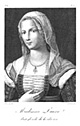
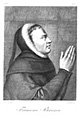
Consequently, the numbering of the fourth volume of the Rime was modified as follows: the text of the current edition, pp. 457–767; followed by the Dichiarazioni, pp. 319–366; and finally the Biblioteca, pp. 280–483. The latter—which is in fact a bibliography, and whose Proemio (a brief abrégé of the history of bibliography) is essential reading—likely served as the model for Torri’s envisioned “Biblioteca dantesca.” (Antonio Marsand, a renowned Petrarch scholar, was a professor at the University of Padua). To the copy in his possession, he had therefore added Marsand’s commentary (the “illustrations”) from a previous edition, including the portraits of Francesco and Laura. Torri always demonstrated significant attention to the iconographic elements of these works, as is also evident in the copy of
On the inside front cover, in the top right corner, is the likely price of the volume (“FR. 200”), followed by Torri’s text:
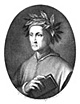
Questa copia […] apparteneva già al sig. Gaetano Poggiali benemerito editore della Divina Commedia, il quale nella sua Serie de’ testi di Lingua…. (Livorno, 1813, vol. 1, p. 16, cfr. stampa) ne lasciò la qui appresso memoria: «Bellissimo esemplare in carta grande con vasti margini, talché sembra di forma in-4°, col Ritratto colla lettera aperta. Esso è stato arricchito col collocamento ai suoi luoghi della figura inventata e disegnata dal celebre Gio. Flaxman, e incisa accuratamente a contorni da Tommaso Piroli, che noi facemmo espressamente tirare su carta grande per unirle al presente esemplare». Io ne feci acquisto nel marzo 1846 dagli eredi Poggiali per mezzo del sig. Carlo [Tenca? : abrasione] intelligente bibliografo, che si compiacque di procurare questo prezioso articolo alla mia collezione dantesca. Alessandro Torri
This copy […] formerly belonged to Mr. Gaetano Poggiali, the renowned editor of the Divina Commedia, who, in his Serie de’ testi di Lingua… (Livorno, 1813, vol. 1, p. 16, cf. printed version), left the following record of it: «A very fine copy on large paper with wide margins, such that it appears to be in quarto (4to) format, with the open letter portrait. It has been enriched by the insertion in their proper places of the figures devised and drawn by the celebrated John Flaxman and accurately engraved in outline by Tommaso Piroli, which we had specially printed on large paper to be included in this copy». I purchased it in March 1846 from the Poggiali heirs through Mr. Carlo [Tenca? : erasure], a discerning bibliographer, who was kind enough to procure this precious item for my Dante collection. Alessandro Torri
In a different hand, he subsequently adds:
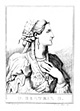
Al volume 2 vi ho aggiunto il corredo di un bel ritratto di Beatrice tirato appositamente in carta grande. Lo feci già incidere dalla valente artista Elvira Rossi di Pisa per la Vita nuova, 1° delle Opere minori di Dante Alighieri da me pubblicate con illustrazioni. A. T.
To volume 2, I have added a fine portrait of Beatrice, specially printed on large paper. I previously commissioned this engraving from the talented Pisan artist Elvira Rossi for the Vita Nuova, the first volume of the Opere minori of Dante Alighieri published by me with illustrations. A. T.
John Flaxman (1755–1826), a renowned English sculptor and engraver, was at that time also a famous illustrator of the Divine Comedy. In the Torri Collection, we find a notice for Atlante dantesco da poter servire ad ogni edizione della Divina Commedia ossia l'Inferno il Purgatorio e il Paradiso composti dal sig. Giovanni Flaxman, gia incisi dal sig. Tommaso Piroli, ed ora rintagliati dal sig. Filippo Pistrucci con aggiunta di nuovi intagli e di una breve descrizione e spiegazione delle tavole, Milano, presso Battelli e Fanfani e si pure presso il Pistrucci suddetto, 1823.
Tommaso Piroli (1750–1824) was also a well-known Italian engraver and the author of a celebrated work of archaeological illustrations, Antichità di Ercolano, Roma, 1789–1807. >
By contrast, nothing is known of Elvira Rossi of Pisa. Meanwhile, both Gaetano Poggiali (1753–1814) and Carlo Tenca (1816–1883) remain relatively well known: the former as a Dante editor and owner of a famous codex (the Poggiali-Vernon manuscript), which Torri knew for containing contemporary commentaries on the Commedia; the latter as a Milanese man of letters and journalist, the leading figure behind Countess Maffei’s renowned literary salon, who was a correspondent of Torri’s.
[1] Memorie di Lorenzo Da Ponte, compendiate da Jacopo Bernardi e scritti vari in prosa e poesia del medesimo autore, Firenze, Le Monnier, 1871; the correspondence is on pp. 197–206