

Andrea Torri Collection - History of the "Dante Library”
[Translation of the original Italian text by Renato Nisticò]
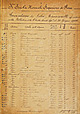
Alessandro Torri donated his «Biblioteca dantesca» (“Dante Library”) to the Scuola Normale in 1855, receiving in return a life annuity («scudi 12 fiorentini mensuali finché dura la mia vita» = “twelve Florentine scudi per month for the duration of my life”) granted by the then Minister of Public Instruction and Charity of the Grand Duchy of Tuscany, Marquis Cesare Boccella, as recorded in a resolution of the Consiglio Direttivo (Governing Council) of the Scuola Normale, preserved among the papers of the Torri Collection. Evidence of this donation is preserved in the first official inventory of the Library from that date onward—namely, the Inventario 1906 (1906 Inventory), which lists all the volumes from Torri’s library held at that time, though not yet recorded as belonging specifically to his collection. The historical significance of the Torri Collection is underscored by the fact that, at the time, it constituted approximately one third of the Scuola Normale Library’s holdings.
The integrity of the collection was preserved for a number of years. An indication of the original arrangement of the Torri Library may be inferred from the classification recorded on the red label affixed to nearly all of its volumes. Subsequently, however, following the reorganization of the Scuola’s Library according to a modern classification system, the Dante Library was likely incorporated into the SNS library general collection, thereby losing its original unity.
In addition to its book holdings, the Torri Collection comprises a body of papers and modern manuscripts, as well as correspondence. The incoming letters have been arranged and catalogued, while the draft copies of Torri’s letters to his correspondents remain to be catalogued.
The Torri Papers are currently arranged in twelve numbered folders containing letters from 267 correspondents received by Torri. The draft copies of the letters sent by Torri, by contrast, are housed in two additional folders, neither numbered nor otherwise marked. These were partially arranged by Torri himself and are now divided by letter into open file folders; however, unlike the incoming correspondence, they have not been catalogued using movable index cards and are therefore accessible only through manual consultation. Among the papers there is also a list of Torri’s correspondents drawn up by Torri himself, including, among others: Centofanti, D’Ancona, the publisher Le Monnier, Mayer, Mazzoni, Missirini, the publisher Molini, Muzzi, Kirkup, Tenca, Vieusseux, and many others. There are also eight additional folders containing preparatory materials for editions of Dante’s works (one, in particular, is devoted exclusively to the Visio Tnugdali).
Distributed among the two aforementioned types of “miscellaneous” folders are additional documents, including lists of the works on Dante donated by Torri to the Scuola Normale and, more generally, documents relating to this transaction, from which the information reported above has been drawn. Also included is a substantial manuscript copy of excerpts from Gabriele Rossetti’s Sullo spirito antipapale che produsse la Riforma (1832), transcribed in 1840. These documents correspond to entry numbers 6444–6447 in the "Inventory of the Library as of 30 June 1906 – Copy".
Subsequently, the Dante Library strictly understood that is the book collection forming part of the Collection, was dispersed and incorporated into the general SNS Library holdings. One of the aims of the present project is also to reconstitute the Torri Library as a distinct entity, to which a dedicated search interface in the online catalogue has been assigned.
Subsequently, the Dante Library, as the book component of the Torri Collection, was dispersed and incorporated into the general holdings of the SNS Library. One of the aims of the present project is also to reconstitute the Library as a unified entity, to which a dedicated search set has been assigned in the online catalogue.
As noted, the entire Torri Collection—not just the Dante Library—was originally estimated to comprise approximately 2,000 items (Pino Simoni, in his Profilo, gives the exact figure of 2,077). In the aforementioned Inventory, the manuscripts and papers of Torri are also recorded, generically identified as “on Dante,” but they do not constitute bibliographic units. The actual number of items is therefore certainly lower.
With regard to the Dante Library in the strict sense, the situation is rather complex. According to a draft of the “Epilogue” to the “Catalogue of Works” to be donated to the SNS Library, preserved among Torriani’s papers, the aforementioned works in fact include:
A) 84 original editions of the Divina Commedia (Divine Comedy); B) 76 original editions of Dante’s individual minor works; C) 7 editions of the minor works collected in single volumes; D) a collection of 1,439 pamphlets concerning Dante’s works; E) the set of 56 volumes of Opuscoli sopra Dante (comprising a total of 619 individual items); F) 48 Greek and Latin works; G) ten volumes containing 318 “poems on Dante”; H) 56 inscriptions in honor of Dante. The total number of individual “items” would amount to 1,988; however, it should be noted that sections G and H include manuscript sheets rather than bound volumes. The total number of volumes would therefore decrease to 1,620. As for section D, which represents the largest category, no trace has been found. These are, in any case, pamphlets which—according to Torri elsewhere in his papers—are often duplicates of those listed under E. If we therefore subtract at least a further six hundred “items,” we approach a more realistic figure of approximately 1,000.
Under D, I also include the classics of Italian literature not directly related to Dante, which have nonetheless been recovered in the course of our work to reconstruct the Torri Library as a unified collection. The number currently reached (651), although likely to increase, is thus, all things considered, fairly close to what can now be recovered of the original Library.
As we have seen, the “Dante Library” does not contain only Dante; it also includes the other great authors of Italian literature, some minor writers, works on language and the history of the Italian language, as well as teaching aids; early printed books (ranging from manuscripts and incunabula—now all lost—to eighteenth-century editions); works of Latin and Greek literature; books on history; books on geography; and books about books, that is, bibliographies.
Within the “Dante Library” proper, a distinction must in turn be made between individual volumes and the Opuscoli sopra Dante, gathered into tomes arranged in numerical series (originally 56), which bind together—generally according to thematic groupings—pamphlets on Dantean subjects. These treat Dante directly or indirectly and include, in addition to a handwritten index, various bibliographical notes and marginal annotations, likewise by Torri. In a letter to D’Ancona one may read a detailed self-description of the Dante Library, or “Italian Encyclopedia,” as he would likewise have wished to call it.