

A. Torri Library - Il “sibillone” di Alessandro Torri
Translation in progress
[Translation of the original Italian text by Selene Maria Vatteroni]
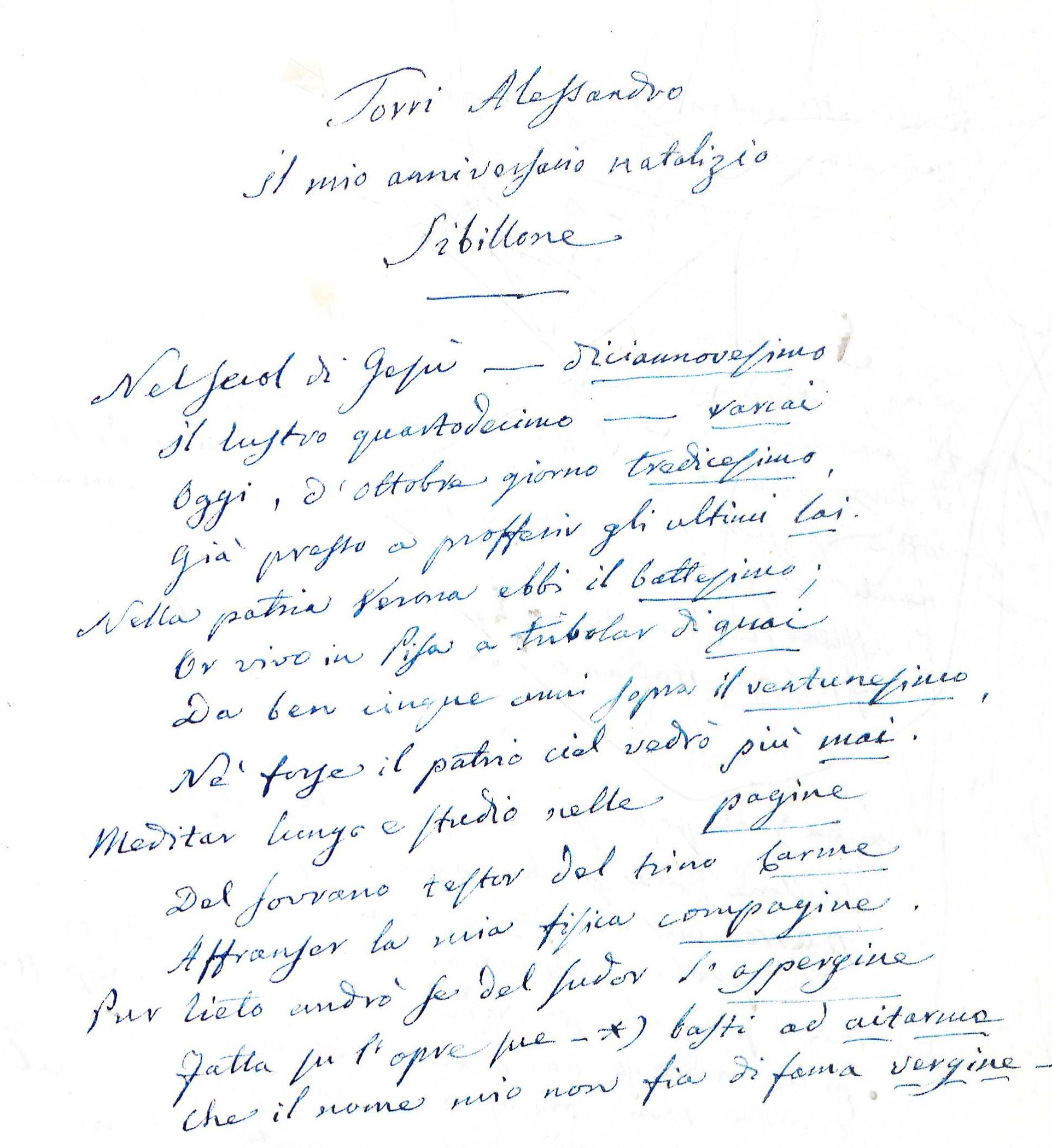
The curious term sibillone, meaning a ‘sonnet with a mandatory rhyme scheme,’ serves as the subtitle to the autobiographical sonnet Il mio anniversario natalizio [My Birthday Anniversary], which Torri composed on the occasion of his 70th birthday on October 13, 1850 (as is evident from lines 1–3). The text is as follows:
"Nel secol di Gesù diciannovesimo
Il lustro quartodecimo varcai
Oggi, d’ottobre giorno tredicesimo,
Già presso a profferir gli ultimi lai. 4Nella patria Verona ebbi il battesimo;
Or vivo in Pisa a tribolar di guai
Da ben cinque anni sopra il ventunesimo,
Nè forse il patrio ciel vedrò più mai. 8Meditar lungo e studio nelle pagine
Del sovrano testor del trino Carme
Affranser la mia fisica compagine. 11Pur lieto andrò se del sudor l’aspergine
Fatta su l’opre sue basti ad aitarme
Che il nome mio non fia di fama vergine."
The sibillone is preserved in the author’s autograph copy within a manuscript miscellany of “miscellaneous poems and Italian, Latin, and French inscriptions on Dante Allighieri” which – as inferred from the title page – Torri began collecting in 1854 in this volume “and in nine others [corrected from seven] in print.” This refers to the miscellaneous volumes of printed pamphlets and offprints entitled Poesie sopra Dante, which form part of the Torri collection of Opuscoli sopra Dante held in the Collection (only eight of them can be traced, however: Misc. 01–Misc. 07 and Misc. 09). .
The sonnet is accompanied by three explanatory notes by Torri himself, indicated respectively by one, two, and three asterisks. The first, at lines 12–13, accounts for his Dantean labors—namely, the edition of the Ottimo commento to the Commedia and that of Alighieri’s minor works—which, however, would never be “completed,” because the volumes of the Convivio and the Rime were never published:
*) Dopo la Divina Commedia col comento intitolato l’Ottimo dell’Anonimo contemporaneo di Dante, testo di lingua da me pubblicato nel 1829 (Pisa, 3 vol.I in –8o fig.), posi in ordine una compiuta edizione delle Prose e delle Poesie liriche dello stesso Allighieri, alcune delle quali inedite, corredandole di note e illustrazioni d’altri e mie (Livorno, 1843-50, vol. in – 8o, quattro dei quali ormai venuti in luce).

The second note, on the final line, comments on the use of the adjective vergine by invoking the authority—not only stylistic but also ideological—of Manzoni’s Il cinque maggio (lines 19–20):
**) L’obbligo della rima mi fece ricorrere per questa frase all’autorità di quel grande, che disse la sua musa
“Vergin di servo encomio
E di codardo oltraggio”.
Sembrami però lecito nè immodesto il desiderio, che almen dopo morte non resti vergine di qualche fama o grata memoria ne’ posteri il nome di chi, avendo dedicato i floridi anni della vita al servigio della patria, consacrò i rimanenti a promovere, non senza profitto altrui, l’affetto ed il culto al più eminente poeta e filosofo italiano."

Ever since his youth in Verona, in fact, Torri embraced the ideals of the Risorgimento; for this reason – as he recounts in lines 5–8 of the Sibillone – in 1822 he felt compelled to relocate to the freer and more hospitable Tuscany, first to Florence and then, from 1826, permanently to Pisa. In his native land, Torri had abandoned a legal career to place himself, as he put it, “at the service of the homeland,” holding numerous public offices – he was, for instance, section chief of the police and later of the prefecture, as well as a member of the departmental examining board for teachers and a departmental inspector of press and books –,[1] but as early as 1814, at the dawn of the Restoration, he chose to bring this career to an end as well, “refusing to continue in employment at the service of a non-national Government,” as can be read in his letter to Matteo Marcacci dated October 30, 1850.[2] From that moment, Torri began dedicating himself full-time to his activities as a bookseller-publisher and as a scholar, focusing especially on Dante, who not by chance is the only author mentioned both in the sonnet (as the “weaver of the threefold Poem,” that is, the Commedia) and in the note (as the greatest Italian “poet and philosopher”). This was the pursuit that Torri then continued during his Tuscan “exile”: certainly, when he writes in the introduction to the Vita nuova (Livorno, Vannini, 1843) that in the study of Dante’s works
"trovarono qualche conforto le incresciose vicende della mia vita; avendomi egli insegnato ad esser tetragono ai colpi di sventura, ed a soffrire con dignitosa rassegnazione[.]"
He is referring precisely to the painful departure from his homeland of Verona, which—by a twist of fate—had instead offered refuge to the exiled Dante. Torri does not fail to emphasize the invaluable service his work as a Dante scholar rendered to the community of scholars, what he elsewhere terms the “republic of letters”: his volumes of the Prose e poesie liriche di Dante Allighieri, for instance, are accompanied by “notes and illustrations” from previous editors as well—as he recalls in the first note—specifically to aid other researchers in their bibliographical research, and they frequently include lexical indexes for the benefit, in particular, of historians of the language. The second note contains a cross-reference to a third and final one, which brings us back to the sonnet and the miscellany in which it is collected:
***) Ho posto qui non per vanto questo mio Sibillone, ma perché parlandovisi di Dante, parevami non doversi escludere da una raccolta poetica risguardante al sommo Autore, tanto più ch’esso diede motivo a due risposte pure in versi de’ miei concittadini Caterina Contessa Bon-Brenzoni, e Dott. Filippo Caval. Scolari sotto i n.ri [spazio bianco] del presente volume. Aless.o Torri."
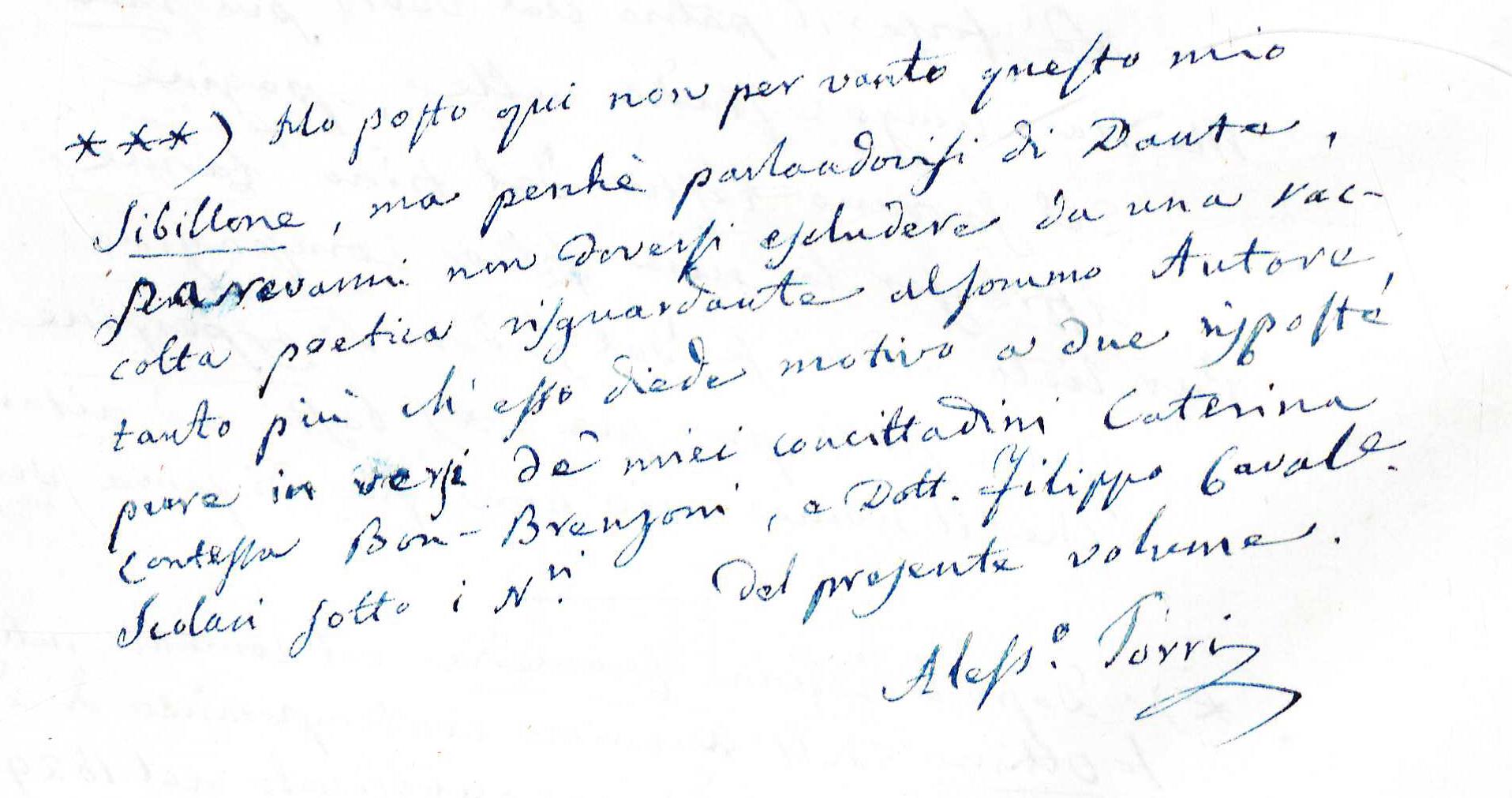
The existence of these two replies is all the more curious when one considers that the word sibillone originally designated a game widespread in literary academies. This game consisted of proposing a topic to someone who, acting as a sibyl, was expected to give bizarre and obscure answers that the remaining participants were then challenged to decipher.
The countess’s responsive sonnet, which adopts the rhyme-words of the Sibillone, appears in an autograph copy by Torri on one of the opening leaves of the miscellany:
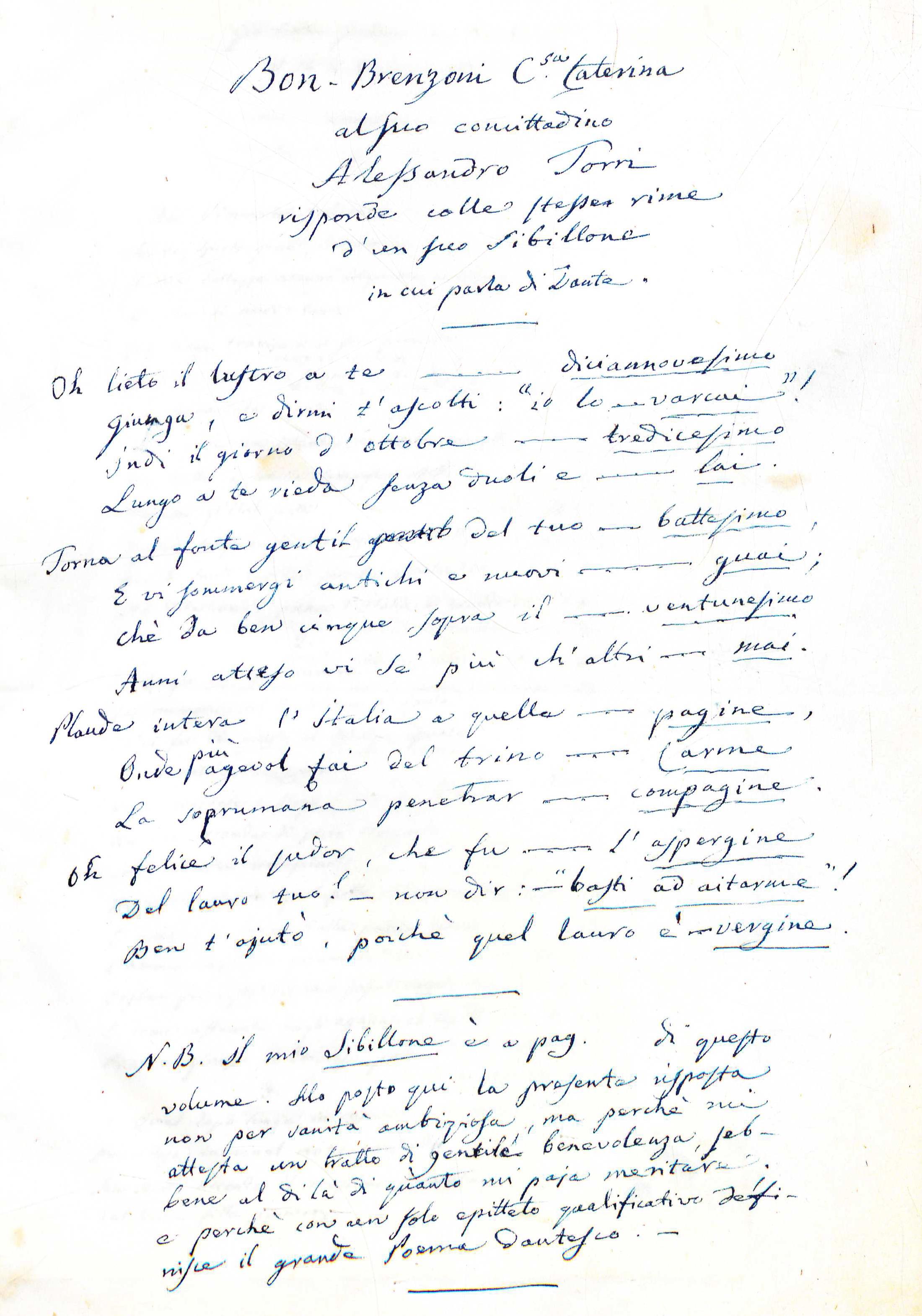
Bon Brenzoni C.sa Caterina al suo concittadino Alessandro Torri risponde colle stesse rime d’un suo sibillone in cui parla di Dante.
O lieto il lustro a te diciannovesimo
Giunga, e dirmi t’ascolti: «io lo varcai»!
Indi il giorno d’ottobre tredicesimo
Lungo a te rieda senza duoli e lai liai. 4Torna al fonte gentil del tuo battesimo,
E vi sommergi antichi e nuovi guai;
Chè da ben cinque sopra il ventunesimo
Anni atteso vi se’ più ch’altri mai. 8Plaude intera l’Italia a quelle pagine,
onde più agevol fai del trino Carme
la soprumana penetrar compagine. 11Oh felice il sudor, che fu l’aspergine
Del lauro tuo! non dir: «basti ad aitarme»!
Ben t’aiutò, poiché quel lauro è vergine."
In this case too, a note by Torri himself follows:
"NB. Il mio Sibillone è a pag. [spazio bianco] di questo volume. Ho posto qui la presente risposta non per vanità ambiziosa, ma perché mi attesta un tratto di gentile benevolenza, sebbene al di là di quanto mi paia meritare, e perché con un solo epitteto qualificativo definisce il grande Poema dantesco."
Caterina Bon Brenzoni (1813–1856) from Verona, a poetess – also the author of patriotic poetry – and the host of a literary salon, maintained a relationship of “sincere sympathy and friendship” with Torri. The latter published her short poem Dante e Beatrice (Pisa, Pieraccini, 1853), which was originally intended precisely for a collection of poems on Dante that was to be issued as the tenth aneddoto [installment] of the Nuova serie di aneddoti danteschi planned by Torri himself (cf. «L’Etruria. Studj di filologia, di letteratura, di pubblica istruzione e di belle arti, II, 1852, pp. 443–448, as well as the final note to the edition of the poem, an annotated copy of which is preserved in the A. Torri Collection, Miscellanea 9, no. 5, p. 28). Of the countess’s sonnet, he must have particularly appreciated lines 9–11, in which Caterina praises the usefulness of his edition of Dante’s minor works for the study of the “superhuman [...] structure” of the Commedia (this being the epithet he liked so much): in the introductions to the individual volumes, Torri had indeed reiterated that his purpose was precisely to provide a tool for a “preparatory introduction” to the study of the poem, or rather a “guide to its understanding.”
The second reply, this time not sharing the same rhyme-words, is by the Venetian Filippo Scolari (1792–1872), a public official and man of letters, notably an exponent of the Catholic current of Dante criticism. His sonnet is located, again in an autograph copy by Torri, a few leaves before the Sibillone:

Scolari Cav. Dott. Filippo ad Alessandro Torri benemerito ed accurato editore ed illustratore delle Opere minori di Dante Allighieri. Sonetto 1852.
Poiché dall’Allighier potesti attingere
Tanta virtù, che ne’ suoi scritti imprimere
Il tuo nome sapesti, e tanto esprimere
Di valor, che n’avesti un serto a cingere; 4Lieto ben puoi della tua vita spingere
Il corso, nè temer che gli anni opprimere
Possan tue laudi: il merto per deprimere
Tempo non val, nè addietro il può respingere. 8Te l’Adige natio, te l’Arno e il Tevere,
Te onoreranno insiem le terre Ausonie,
Cui puro desti a sì gran fonte bevere. 11Dell’immortalità le Dive Aonie
I tuoi pari nel seno aman ricevere,
E son dantesche, quanto son meonie."
In this case too, a note by Torri himself follows:
"È in risposta al mio Sibillone sul mio anniversario natalizio stampato l’anno scorso. Debbo all’antica amicizia dell’Autore questa dimostrazione d’affetto, come incoraggiamento a continuar con ardore i comuni studi danteschi; ben lungi ch’io mi creda degno dei prodigativi encomi. Aless.o Torri."
In fact, the Sibillone was printed in Pisa by the Prosperi printing press in 1855 (which means that this note dates back to 1856, when Torri was still finishing compiling the miscellany) on loose sheets – two of which are preserved among the papers of the Collection – complete with the author’s notes.
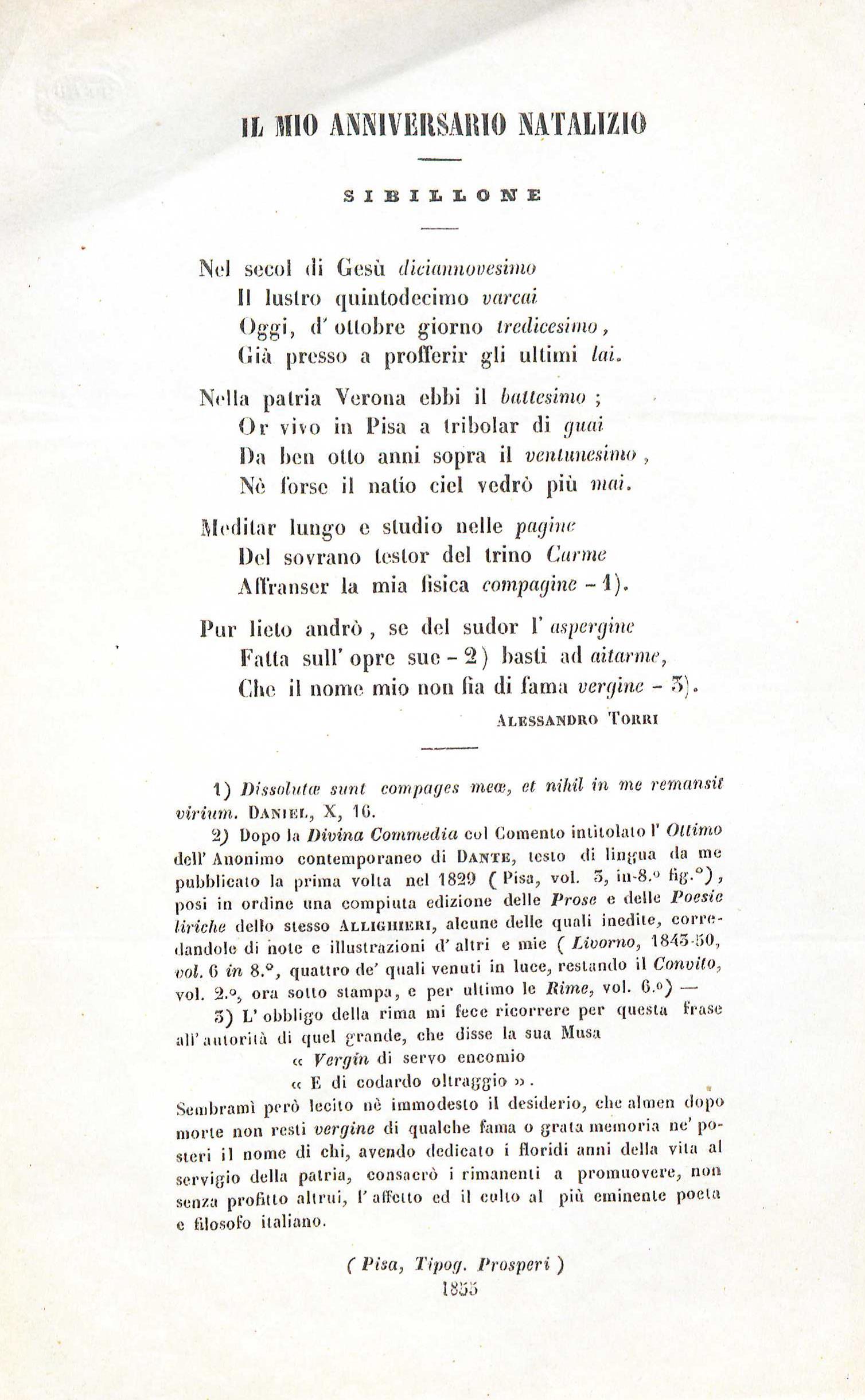
In the printed version, several interesting differences from the manuscript copy can be observed. First of all, in line 2 of the sonnet, it reads “lustro quintodecimo” [fifteenth lustrum] instead of “lustro quartodecimo” [fourteenth lustrum], since by 1855 Torri was indeed celebrating his 75th birthday; furthermore, in line 8, it reads “natío ciel” [native sky] in place of “patrio ciel” [homeland sky]. The notes are also subject to some adjustments: the third note disappears, and with it the mention of the two response sonnets; instead, a new note 1 is added, which comments on the term compagine in line 11 by referencing a biblical passage (“Dissolutœ sunt compages meœ, et nihil in me remansit virium. Daniel, X, 16”); the second note, now shifted to number 3, remains unchanged; while in the first, which became note 2, there is a bibliographical update regarding Torri’s edition of Dante’s minor works:
"[...] posi in ordine una compiuta edizione delle Prose e delle Poesie liriche dello stesso Allighieri [...] (Livorno, 1843-50, vol. 6 in 8o, quattro de’ quali venuti in luce, restando il Convito, vol. 2o, ora sotto stampa, e per ultimo le Rime, vol. 6o)."
As mentioned at the beginning, these two volumes would never actually be published – not even the Convito, which in 1855 was indeed “in press,” as demonstrated by the galley proof copy preserved in the Collection –, due to the financial hardships that Torri laments as early as 1850, in a letter to Scolari himself dated October 20:
"Già fin d’ora sto preparando la stampa del Convito, e farò di tutto, perché venga a luce colle future violette, se pure l’incasso del Vol. 4o [= Della lingua volgare di Dante Allighieri] rifarà le spese, e lascierà al tipografo un avanzo per continuare. Già di compensi per me non è ancora il caso di parlare, poichè altrimenti non si andrebbe avanti coll’edizione. Ecco la incoraggiante posizione degli Editori in Italia!"
and again in 1852, in another letter to his friend dated 23 November, he states that “the same reasons are delaying the Convito.[3] This explains why, in that same year, Filippo sent him the following sonnet of “encouragement” and praise for his work as editor of Dante’s minor writings. Such work not only brought him renown throughout Italy (the “Ausonian lands”), but also made him worthy of standing in the presence of the Muses (the “Aonian Divinities”), among whom dwell Dante himself and Homer (the meaning of line 14). It should be noted, however, that the sonnet predates the letter of 23 November. It was in fact published as a note to Scolari’s letter to Torri that appeared in the April issue of «Etruria» (vol. II, 1852, although the letter itself is dated 12 April 1851), almost as a form of compensation for the arguments advanced there— and not without a certain degree of resentment—by the author against Dante’s authorship of the De vulgari eloquentia, a position that Torri, by contrast, firmly upheld.
[1] Cfr. Pino Simoni, Profilo bio-bibliografico di Alessandro Torri, in «Studi storici Luigi Simeoni», 42, 1992, pp. 117-146, a p. 119.
[2] Cfr. Abd-El-Kader Salza, Dal carteggio di Alessandro Torri. Lettere scelte sugli autografi e postillate, Pisa, Nistri, 1897, p. v.
[3] Cfr. Averardo Pippi, Otto lettere di Alessandro Torri a Filippo Scolari, Firenze, Landi, 1889, pp. 24 e 25.